My Account


Discover how waterjetting can be used for industrial cleaning, coating removal and concrete remediation, and when manual or robotic equipment may be appropriate.
Explore this guide:
Understanding Waterjetting

What is waterjetting?
Waterjetting is the use of pressurised water to clean, prepare, cut or remove material from a surface. Depending on the pressure, water flow, nozzle and application tool, it can be used for anything from industrial cleaning to demanding coating removal and concrete demolition.
Unlike abrasive blasting, water jetting does not usually require abrasive media to strike the surface. This can significantly reduce the volume of spent abrasive that needs to be collected, transported and disposed of after the work while also helping reduce airborne dust.
The result depends on more than pressure alone. Water flow, nozzle design, stand-off distance, travel speed and the condition of the material all influence performance.
What is ultra-high-pressure waterjetting?
What is ultra-high-pressure waterjetting?
Ultra-high-pressure waterjetting, commonly shortened to UHP waterjetting, uses specialised pumps and tooling to deliver water at extremely high pressures for demanding cleaning, coating removal and surface-preparation work. It is commonly used where conventional high-pressure waterjetting does not provide sufficient energy to remove tightly bonded coatings, corrosion, scale or contamination.
UHP waterjetting can remove coatings and contaminants without introducing abrasive media, making it particularly useful for industrial surface preparation where reducing spent abrasive waste is a priority. However, the required surface condition, production rate and effectiveness depend on the complete system configuration, not pressure alone.
What is hydrodemolition?
Hydrodemolition is a controlled concrete-removal process that uses high-pressure water to selectively remove deteriorated, damaged concrete. It is commonly considered where the objective is to remove unsuitable concrete while preserving reinforcing steel and as much sound surrounding concrete as possible.
In simple terms
Waterjetting is the broader technology. Hydro demolition is a specialized form of water jetting used in the remediation of concrete.
What is robotic waterjetting?
Robotic waterjetting uses remotely operated equipment to position and move the waterjetting tool across a surface. Depending on the machine, robotic systems can work on floors, walls, curved structures and overhead areas.
Robotic equipment can improve consistency by controlling travel speed and nozzle stand-off. It can also increase the distance between the operator and the active nozzle, although trained personnel, exclusion zones, PPE and safe operating procedures are still required.
Pressure washing, waterjetting and hydrodemolition
METHOD
PRIMARY PURPOSE
COMMON USES
Pressure washing
General cleaning
Dirt, loose deposits and routine surface cleaning
High-pressure waterjetting
More demanding cleaning and coating removal
Deposits, coatings, scale and industrial cleaning
UHP waterjetting
Heavy-duty coating removal and surface preparation
Coatings, corrosion, contamination and surface preparation
Hydrodemolition
Controlled concrete removal
Concrete repair, rebar exposure and deteriorated concrete removal
These descriptions are useful starting points. The final equipment selection should be based on the surface, required result, access conditions and project controls.
Understanding the Difference
While pressure washing and waterjetting are commonly used for cleaning and surface preparation, hydrodemolition applies high-pressure water technology specifically to concrete removal and remediation.
The next section explores how hydrodemolition works, where it is used, and why contractors may choose it over traditional mechanical concrete-removal methods.
Understanding Hydrodemolition
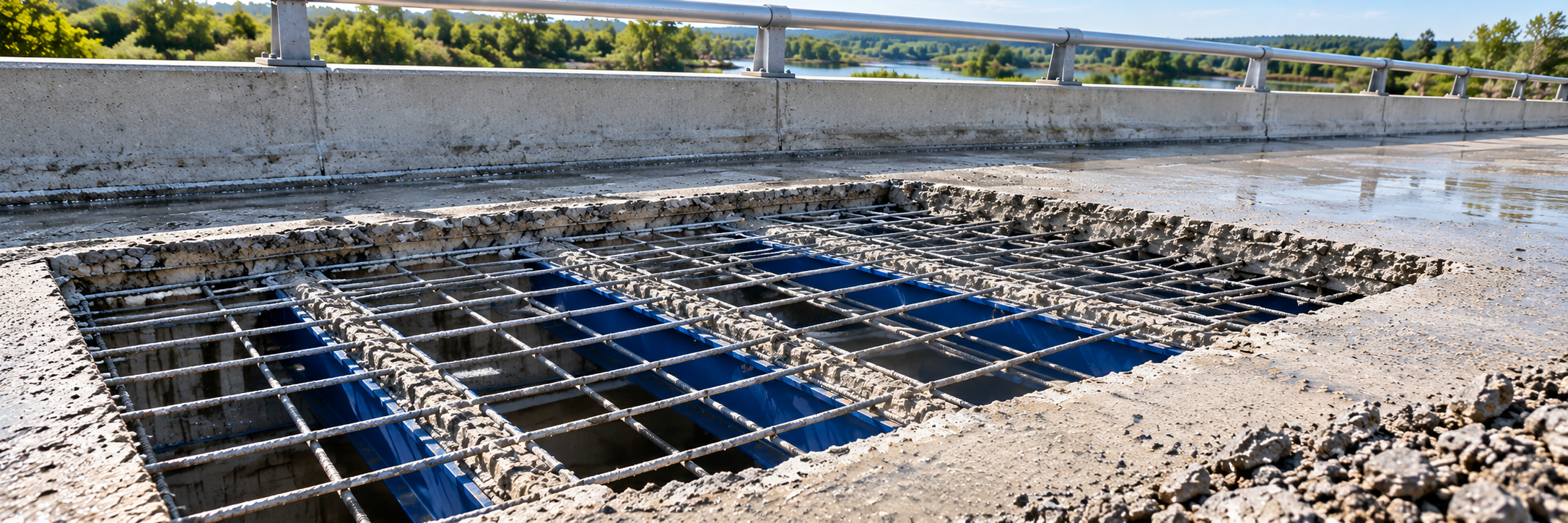
What is hydrodemolition?
Hydrodemolition is a controlled concrete-removal process that uses high-pressure water to selectively remove deteriorated, damaged or unwanted concrete. It is commonly used where the objective is to remove unsuitable concrete while preserving reinforcing steel and as much sound surrounding concrete as possible.
Unlike traditional mechanical demolition methods, hydrodemolition uses the energy of a high-pressure water stream rather than repeated mechanical impact to break apart and remove concrete.
In simple terms
Waterjetting is the broader technology. Hydrodemolition is a specialised application of waterjetting used for concrete removal and remediation.
How does hydrodemolition work?
Hydrodemolition uses specialised high-pressure pumps and waterjetting tools to direct powerful water streams onto a concrete surface. The water penetrates cracks, pores and weakened areas of the concrete, creating forces that fracture and dislodge material.
Depending on the application, the equipment can be configured to remove a controlled depth of concrete or target deteriorated material while retaining sound surrounding concrete.
Robotic hydrodemolition equipment is commonly used to control nozzle movement, travel speed and removal patterns across larger areas. Manual tools may be appropriate for smaller, localised repairs or areas with restricted access.
The effectiveness of the process depends on water pressure, flow, nozzle configuration, concrete condition, travel speed and the required removal depth.
Why use hydrodemolition instead of mechanical removal?
Hydrodemolition offers several advantages over conventional mechanical concrete-removal methods, particularly where the remaining structure and reinforcing steel must be protected.
CONSIDERATION
HYDRODEMOLITION
MECHANICAL REMOVAL
Removal method
High-pressure water energy
Impact, cutting or grinding
Reinforcing steel
Reinforcing steel Can remove concrete around reinforcement without directly cutting the steel
May require additional care to avoid reinforcement damage
Impact and vibration
Avoids repeated mechanical impacts
Impact tools can introduce vibration and shock
Remaining concrete
Can reduce the risk of impact-induced microcracking
Impact methods may introduce microcracking
Surface condition
Produces a roughened surface suitable for many concrete repair applications
Surface characteristics depend on the tool and method
Waste management
Requires collection and management of wastewater and concrete debris
Requires management of dust, rubble and other debris
| Requires management of dust, rubble and other debris |
The suitability of either method depends on the concrete condition, structural requirements, access, environmental controls and project specifications.
When is hydrodemolition appropriate?
Hydrodemolition is commonly considered when deteriorated concrete must be removed while protecting the remaining structure or reinforcing steel.
It can be particularly useful for concrete rehabilitation projects where selective removal, reduced mechanical impact and preparation of the remaining surface for repair are important.
However, hydrodemolition is not necessarily the most practical solution for every project. Water availability, wastewater containment, equipment access, removal depth, production requirements and the condition of the existing concrete must all be considered.
The next section explores where waterjetting and hydrodemolition are commonly used across industrial, civil infrastructure and transport applications.
Where Waterjetting and Hydrodemolition Are Used
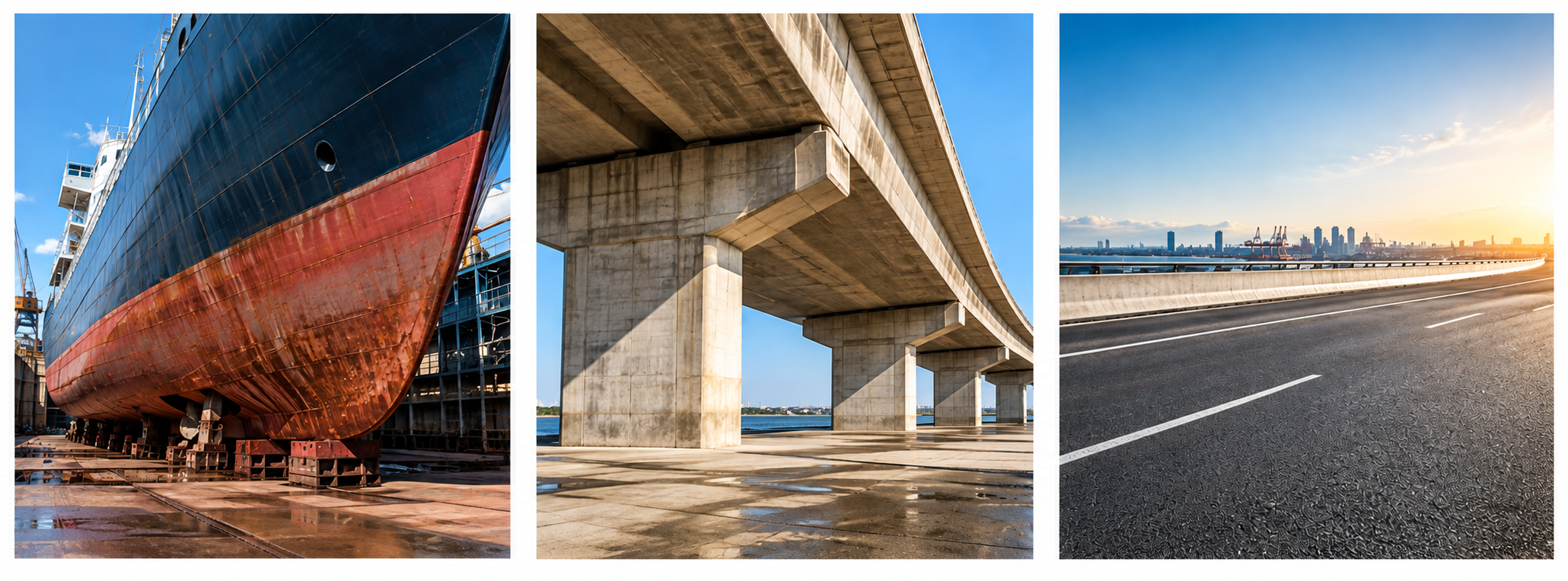
Waterjetting and hydrodemolition are used across civil infrastructure, industrial maintenance, marine facilities, construction, oil and gas, concrete repair and transport projects.
While waterjetting is commonly used for cleaning, coating removal and surface preparation, hydrodemolition is specifically used for controlled concrete removal and rehabilitation.
Surface Preparation and Coating Removal
- Coating removal
- Rust and scale removal
- Tank and vessel cleaning
- Pipeline and penstock cleaning
- Ship hull preparation
- Process buildup removal
Concrete and infrastructure
Hydrodemolition is particularly useful for infrastructure rehabilitation projects where deteriorated concrete must be removed while preserving reinforcing steel and sound surrounding concrete.
- Concrete cancer removal
- Rebar exposure
- Bridge deck repair
- Tunnel restoration
- Parking structure repair
- Dams and spillways
- Wharves and marine structures
Roads and transport
- Road marking removal
- Pavement preparation
- Rubber deposit removal
- Hardstand cleaning
- Preparation for replacement coatings and markings
Why Contractors Choose These Methods
Key Benefits of UHP Waterjetting and Hydrodemolition
Waterjetting and hydrodemolition offer several advantages over conventional surface preparation and concrete-removal methods. Depending on the application, these technologies can improve removal efficiency, reduce certain environmental impacts and help protect the underlying structure.
Effective Surface Preparation
High-pressure water can remove coatings, corrosion, contamination and deteriorated concrete. In hydrodemolition applications, the process can selectively remove weakened concrete while producing a roughened surface suitable for subsequent repair and bonding.
Less Airborne Dust
Water-based removal methods can generate less airborne dust than dry abrasive blasting, grinding or mechanical demolition. However, appropriate controls are still required to manage water mist, airborne contaminants and removed materials.
Reduced Abrasive Waste
Waterjetting applications that do not use abrasive media eliminate the need to recover and dispose of spent blasting abrasive. This can reduce solid waste volumes, although wastewater, removed coatings and other contaminants must still be collected and managed appropriately.
Robotic Operation
Robotic waterjetting and hydrodemolition systems can improve consistency by controlling nozzle movement, travel speed and stand-off distance. Remote operation can also increase the separation between personnel and the active waterjet, reducing direct operator exposure when appropriate safety controls are in place.
Reduced Impact and Vibration
Unlike mechanical breakers, hydrodemolition does not rely on repeated mechanical impacts to remove concrete. This can reduce vibration and the risk of impact-induced microcracking in the remaining concrete, making it particularly useful for structural rehabilitation projects.
Reinforcing Steel Can Remain in Place
Hydrodemolition can remove deteriorated concrete from around reinforcing steel without the direct cutting action associated with some mechanical removal methods. This allows reinforcement to remain accessible for inspection, treatment and repair while helping preserve sound surrounding concrete.
Manual vs. Robotic Equipment
What Is Manual Waterjetting Best For?
Manual waterjetting is generally best suited to smaller, localised projects, detailed surface preparation and areas where access is restricted or surfaces are irregular.
Handheld equipment provides flexibility when working around corners, edges, complex structures and areas that may be difficult to reach with robotic systems.
Best suited for:
- Small-scale coating and corrosion removal
- Spot repairs and localised surface preparation
- Irregular surfaces, edges and tight-access areas
- Detailed cleaning around structural components
- Short-duration projects where robotic setup may not be practical
What Is Robotic Waterjetting Best For?
Robotic waterjetting is generally best suited to larger projects, repetitive removal tasks and applications where consistent nozzle movement and greater operator separation are important.
Robotic systems use controlled movement to maintain operating parameters across the work area. Depending on the equipment configuration, they can be used for coating removal, surface preparation and concrete hydrodemolition.
Best suited for:
- Large-area coating and corrosion removal
- Bridge decks, concrete slabs and infrastructure rehabilitation
- Controlled concrete removal and rebar exposure
- Repetitive cleaning and surface preparation
- Projects requiring consistent removal patterns
- Applications where remote operation can reduce direct operator exposure
Which Method Should You Choose?
Manual equipment is often the practical choice for smaller, detailed or difficult-to-access areas. Robotic equipment is generally preferable for larger, repeatable work where controlled movement, productivity and operator separation are priorities.
Some projects benefit from a combination of both methods, with robotic systems handling the main removal area and manual tools completing edges, corners and other inaccessible sections.
The final choice depends on surface conditions, access, removal requirements, equipment capabilities and site-specific safety controls.
CONSIDERATION
MANUAL EQUIPMENT
ROBOTIC EQUIPMENT
Project scale
Localised work and smaller areas
Larger, repeatable areas
Surface access
Flexible around corners, edges and irregular details
Suitable for compatible floors, walls, curved surfaces and overhead applications
Consistency
Operator technique has greater influence on results
Controlled travel speed, nozzle movement and stand-off distance
Operator exposure
Operator works closer to the active tool
Remote operation increases separation from the active waterjet
Setup
Often quicker to deploy for smaller tasks
May require additional setup and positioning
Productivity
Suitable for detailed work and smaller removal areas
Can improve productivity and consistency across larger, accessible surfaces
Equipment, Pressure and Safety
What Equipment Is Required?
A complete waterjetting or hydrodemolition system involves more than a high-pressure pump. The correct equipment configuration depends on the application, required pressure and water flow, operating conditions and safety requirements.
- High-pressure or UHP pump: Supplies the pressure and water flow required for the application.
- Manual or robotic tooling: Directs and controls how water energy is applied to the work surface.
- High-pressure hoses and connections: Appropriately rated components deliver pressurised water from the pump to the application tool.
- Nozzles and orifices: Control the water stream characteristics to suit the material being removed and the required result.
- Control and pressure-release systems: Provide the means to control, divert or safely release system pressure.
- Water supply and filtration: Deliver the required water volume and quality while helping protect pumps and other components.
- Containment and recovery: Collect and manage wastewater, concrete debris, removed coatings and other contaminants.
- Waterjetting PPE: Task-specific protective equipment selected for the operating conditions and hazards.
How Much Pressure Is Required?
There is no single correct pressure for every waterjetting or hydrodemolition project. The appropriate pressure and flow depend on the material being removed, the condition of the underlying substrate, the required surface finish and the desired production rate.
Pressure influences the intensity of the water stream, while water flow contributes to the energy delivered and the amount of material that can be removed and flushed from the surface.
Higher pressure does not automatically mean faster or more effective removal. Nozzle configuration, water flow, stand-off distance, travel speed and the characteristics of the material all influence performance.
For hydrodemolition, equipment selection must also consider concrete strength, reinforcement, the required removal depth and the condition of the concrete that must remain.
Questions to Answer Before Selecting Equipment
- What material needs to be removed?
- What is the condition of the underlying substrate?
- What surface condition or removal depth is required?
- What is the total surface area or volume of material to be removed?
- Is the work horizontal, vertical or overhead?
- Is manual or robotic operation more appropriate?
- What access and space are available for equipment?
- What water quality, volume and power are available?
- How will wastewater, debris and contaminants be contained and managed?
Waterjetting Safety and PPE
High-pressure and ultra-high-pressure waterjetting can cause severe injuries, including water injection injuries that may not initially appear serious.
Equipment must only be operated by trained and authorised personnel following manufacturer instructions, site-specific risk assessments, safe work procedures and applicable Australian requirements.
Essential safety considerations include:
- Task-specific operator training and competency
- Appropriate waterjetting protective clothing
- Suitable gloves, boots, face and eye protection
- Correctly rated hoses, fittings and restraints
- Functional emergency stops and pressure-release controls
- Clearly established exclusion zones
- Pre-use equipment inspection and maintenance
- Safe management of wastewater, debris and hazardous contaminants
- Emergency procedures for high-pressure water injection injuries
Important
This page provides general information only. It does not replace formal operator training, manufacturer instructions, site-specific risk assessments, safe work method statements or applicable safety requirements.
For more detailed guidance, refer to our UHP Waterjetting PPE and Safety Guide.
Planning and Choosing a Solution
1. Is Waterjetting or Hydrodemolition Right for Your Project?
Waterjetting and hydrodemolition are not automatically the best solutions for every project. The appropriate method depends on the material being removed, the required surface condition, access restrictions, production requirements and environmental controls.
Waterjetting is commonly considered for industrial cleaning, coating removal and surface preparation, while hydrodemolition is suited to concrete removal and rehabilitation where protecting reinforcement and the remaining structure is important.
Before selecting either method, consider:
- Surface requirements: Will waterjetting achieve the cleanliness, surface profile or concrete removal depth specified?
- Site access: Can the equipment, hoses and support systems be positioned and operated safely?
- Water and power: Are adequate water volume, quality and power available?
- Waste management: Can wastewater, debris and contaminants be contained, collected and disposed of appropriately?
- Project economics: Do mobilisation, equipment setup and production requirements make the method practical?
- Operator competency: Are suitably trained personnel and appropriate safety systems available?
For steel surface preparation, waterjetting does not generally create a new abrasive-blasted surface profile. Existing surface condition, flash rust and coating specifications must be considered.
A trial area is often the most practical way to confirm removal performance and the resulting surface condition before full production begins.
QUICK REFERENCE GUIDE FOR CHOOSING THE BEST METHOD
YOUR PROJECT INVOLVES
TECHNOLOGY TO INVESTIGATE
Removing industrial coatings from steel
UHP waterjetting
Removing deteriorated concrete around reinforcement
Hydrodemolition
Cleaning large, repetitive surface areas
Robotic waterjetting
Detailed work around complex structures
Manual waterjetting
Preparing steel for recoating
Waterjetting, subject to coating specifications
2. How to Plan a Waterjetting or Hydrodemolition Project
Successful projects begin with understanding what needs to be removed, what must remain and how the work can be completed safely and efficiently.
Define
→
Protect
→
Assess
→
Select
→
Trial
STEP
MEANING
01 Define Removal
Identify what needs to be removed, including concrete, coatings, corrosion, scale or contamination. Establish the required removal depth or surface condition.
02 Protect Substrate
Determine what must remain undamaged, such as structural steel, reinforcing steel or sound concrete.
03 Assess Access
Evaluate the work area's size, orientation, accessibility, available services and environmental restrictions.
04 Select System
Choose the appropriate pump, pressure, water flow, manual or robotic tooling, containment and safety controls.
05 Trial Area
Test the proposed system on a representative area to assess removal performance, surface condition and production rate before full-scale work.
3. Should You Hire or Purchase Waterjetting Equipment?
Hiring or purchasing depends on how frequently the equipment will be used, the type of projects undertaken and the resources available to operate and maintain the system.
When Hiring Makes Sense
Hiring is often the practical choice for contractors undertaking a defined project, testing a new application or requiring specialised equipment that will not be used regularly.
It can provide access to high-pressure pumps, robotic tooling and supporting equipment without the initial investment of purchasing a complete system.
Hiring may be best when:
- Equipment is required for a short-term or one-off project.
- The application requires specialised equipment.
- Project requirements vary significantly.
- Equipment utilisation does not justify ownership.
- A contractor wants to evaluate a system before purchasing.
When Purchasing Makes Sense
Purchasing may be more suitable for contractors who regularly undertake waterjetting or hydrodemolition work and have the personnel, maintenance capabilities and project pipeline to support equipment ownership.
Purchasing may be best when:
- Waterjetting is part of ongoing operations.
- Equipment will be used frequently.
- Consistent equipment availability is important.
- Trained operators and maintenance resources are available.
- Long-term utilisation supports the investment.
Consider the Complete System
The decision should account for more than the pump itself. Tooling, hoses, nozzles, controls, PPE, water supply, filtration, containment, maintenance, operator training and technical support all contribute to the total cost of operation.
BlastOne can help contractors evaluate equipment configurations and determine whether hiring or purchasing is the more practical solution for their application.
Frequently Asked Questions
Can waterjetting remove industrial coatings?
Yes. High-pressure and ultra-high-pressure waterjetting can remove many industrial coatings, including protective coatings from steel and concrete surfaces. Effectiveness depends on coating type, adhesion, water pressure, flow and nozzle configuration.
What pressure is needed for waterjetting or hydrodemolition?
There is no single pressure suitable for every application. The required pressure and flow depend on the material being removed, substrate condition, removal depth and production requirements. The complete system should be selected for the intended application rather than pressure alone.
Is hydrodemolition the same as waterjetting?
Hydrodemolition is a specialised application of high-pressure waterjetting used for controlled concrete removal. While waterjetting covers a broad range of cleaning and surface preparation tasks, hydrodemolition specifically focuses on concrete removal and rehabilitation.Can hydrodemolition remove concrete without damaging reinforcing steel?
Hydrodemolition can remove concrete from around reinforcing steel while helping preserve the reinforcement. However, the condition of the steel, equipment configuration and removal requirements must be assessed before work begins.
When should I use manual rather than robotic waterjetting?
Manual equipment is generally best for smaller areas, detailed work and restricted-access locations. Robotic systems are often better suited to larger, repetitive projects where consistent nozzle movement and increased operator separation are important.
Can waterjetting and hydrodemolition equipment be hired?
Yes. Depending on availability and project requirements, contractors may be able to hire high-pressure pumps, application tools, robotic equipment and supporting components. BlastOne can help identify suitable equipment options for the application.
Should I hire or purchase waterjetting equipment?
Hiring may be more practical for short-term projects, specialised applications or occasional use. Purchasing may offer better long-term value when equipment is used regularly and the business has trained operators and maintenance resources.
Does waterjetting eliminate the need for wastewater management?
No. Although non-abrasive waterjetting can reduce spent abrasive waste, wastewater, removed coatings, concrete debris and contaminants still require appropriate containment, collection and disposal.
Talk to a BlastOne Specialist
Not sure which waterjetting system fits your project?
Advise the BlastOne team what needs to be removed and the required objective for your specific project, what must remain and which access or environmental constraints apply and we will work with you to not only achieve this but provide the best advice and equipment for the project.
Contact BlastOne
We love to talk to customers and help them make the best decisions when purchasing Air preparation and drying equipment.
You can reach us via our Live Chat, Email, Phone, and Online Form.